Unit 5
My new house
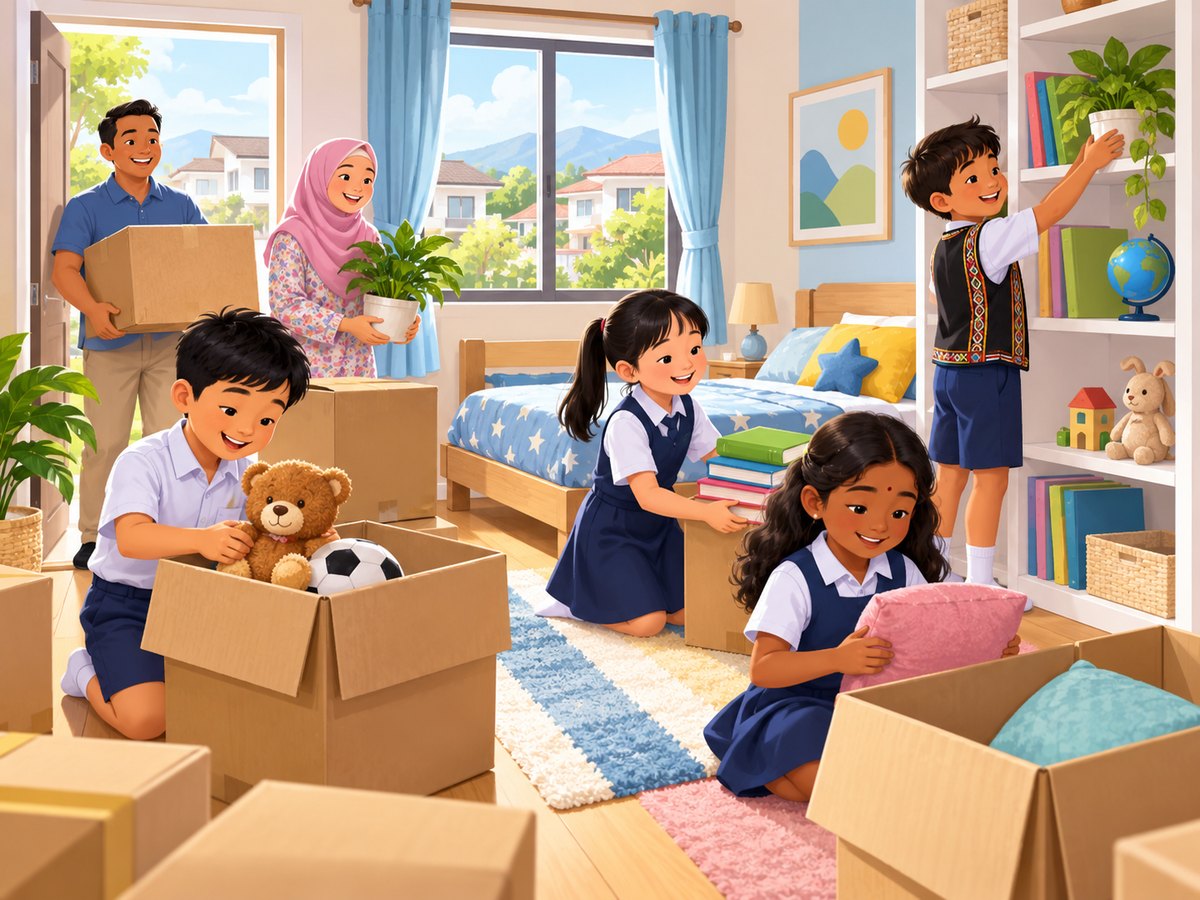
Move into a new house! Name the rooms and furniture, say where things are, ask whose things they are, and describe a home with there is and there are.
New words
Parts of a house
doorYou open it to go in or out.
floorYou walk on it.
wallPaintings hang on it.
upstairson the top floor of a house
downstairson the bottom floor of a house
hallthe space just inside the front door
upstairs / downstairs = 楼上/楼下
这些词说的是房子的各个部分。door 是门,floor 是地板,wall 是墙,hall 是进门后的门厅。upstairs 是在楼上,downstairs 是在楼下。
例子:My bedroom is upstairs and the kitchen is downstairs.(我的卧室在楼上,厨房在楼下。)
注意:floor 是脚踩的地面,wall 是竖起来的墙,两个不要混淆。
upstairs / downstairs = tingkat atas / tingkat bawah
Perkataan ini menamakan bahagian rumah. Door ialah pintu, floor ialah lantai, wall ialah dinding dan hall ialah ruang masuk di belakang pintu depan.
Contoh: My bedroom is upstairs and the kitchen is downstairs. (Bilik tidur saya di tingkat atas dan dapur di tingkat bawah.)
Awas: Floor ialah tempat kita berpijak, manakala wall berdiri tegak. Jangan tertukar.
Look and say
Where is it?
These words tell us where something is: in, on, under, behind, in front of, next to and between. The ball is under the bed. The lamp is between the bed and the chair.
The toys are in front of the wardrobe.
My shoes are next to the door.
behind / in front of = 在……后面/在……前面
这些介词告诉别人东西在哪里。in 在里面,on 在上面,under 在下面,next to 在旁边,between 在两样东西中间。
例子:The bag is between the desk and the bed.(书包在书桌和床中间。)
注意:in front of 是三个词,要一起用;between 后面要说两样东西,用 and 连起来。
behind / in front of = di belakang / di hadapan
Kata sendi ini memberitahu kedudukan sesuatu benda. In bermaksud di dalam, on di atas, under di bawah, next to di sebelah dan between di antara dua benda.
Contoh: The bag is between the desk and the bed. (Beg itu di antara meja dan katil.)
Awas: In front of terdiri daripada tiga perkataan. Selepas between, sebut dua benda dan sambungkan dengan and.
Try it
We cannot see Tom. The big tree hides him. Tom is ___ the tree.
位置 = position
先想一想:我们看不到 Tom,是因为大树挡住了他。想象你站在树的前面看,Tom 会站在树的哪一边?
例子:The cat is hiding and we can only see its tail.(猫躲起来了,我们只看见它的尾巴。)
注意:如果 Tom 站在树的前面,我们就能看见他了,所以要选相反的位置。
kedudukan = position
Fikirkan mengapa kita tidak nampak Tom. Pokok besar itu menghalang pandangan kita, jadi Tom berdiri di sebelah lain pokok itu.
Contoh: The cat is hiding and we can only see its tail. (Kucing itu menyorok dan kita hanya nampak ekornya.)
Awas: Jika Tom berdiri di hadapan pokok, kita pasti nampak dia. Jadi pilih kedudukan yang bertentangan.
Song
Come and see my house
Come and see my house, my house, my house,
Come and see my house, it's big and new!
My bed is upstairs, the sofa's downstairs,
My cat is under the table, and my ball is, too!
The books are next to the clock,
My coat is behind the door.
Come and see my house, there's so much more!
Come and see my house, it's big and new!
My bed is upstairs, the sofa's downstairs,
My cat is under the table, and my ball is, too!
The books are next to the clock,
My coat is behind the door.
Come and see my house, there's so much more!
Sing and point to each place word: upstairs, downstairs, under, next to, behind.
song = 歌
这首新歌也唱房子:楼上有床,楼下有沙发,猫在桌子下面,书在钟旁边,外套挂在门后面。一边唱,一边找出表示位置的词。
例子:My shoes are under the bed.(我的鞋子在床底下。)
注意:sofa's 是 sofa is 的缩写,不是“沙发的”。
song = lagu
Lagu baharu ini juga tentang rumah. Katil di tingkat atas, sofa di tingkat bawah, kucing di bawah meja dan buku di sebelah jam. Sambil menyanyi, cari perkataan yang menunjukkan kedudukan.
Contoh: My shoes are under the bed. (Kasut saya di bawah katil.)
Awas: Sofa's di sini ialah singkatan sofa is, bukan bermaksud kepunyaan sofa.
Grammar
Where's ...? Where are ...?
Ask about one thing with Where's (Where is). Ask about two or more things with Where are. Answer with It's, He's or She's for one, and They're for more than one.
Where's the dog? It's behind the door.
Where are the toys? They're upstairs.
Where's / Where are = ……在哪里?
问一样东西用 Where's(= Where is),问两样或更多东西用 Where are。回答时,一样东西用 It's,人或宠物可以用 He's/She's,多样东西用 They're。回答时也要看清楚问的是一样还是多样东西,再决定用单数还是复数。
例子:Where are my socks? They're in the drawer.(我的袜子在哪里?在抽屉里。)
注意:trainers、glasses、slippers 这些成对的东西总是用 are 和 They're。
Where's / Where are = di manakah
Tanya tentang satu benda dengan Where's (Where is). Untuk dua benda atau lebih, gunakan Where are. Jawab dengan It's, He's atau She's untuk satu, dan They're untuk banyak.
Contoh: Where are my socks? They're in the drawer. (Di manakah stoking saya? Di dalam laci.)
Awas: Trainers, glasses dan slippers sentiasa berpasangan, jadi gunakan are dan They're.
Try it
Where are the glasses?
glasses = 眼镜
问题用的是 Where are,表示问的东西不止一样。glasses 是一副眼镜,英文当作复数。回答要和复数配合,选主语和动词都正确的句子。
例子:Where are the keys? 回答要用 They 加 are。
注意:They 后面不能接 is;It's 只用来说一样东西。
glasses = cermin mata
Soalan ini bermula dengan Where are, jadi benda yang ditanya lebih daripada satu. Glasses dianggap jamak dalam bahasa Inggeris. Pilih jawapan yang subjek dan kata kerjanya sepadan.
Contoh: Where are the keys? Jawapannya mesti guna They dan are.
Awas: Selepas They, jangan guna is. It's hanya untuk satu benda.
Smart kids
Things in a house
cupboarda box with doors for plates or toys
armchaira soft chair with arms
bookcaseshelves for books
fridgeIt keeps food cold.
wardrobea tall cupboard for clothes
trainerssports shoes
furniture = 家具
cupboard 是有门的柜子,armchair 是有扶手的单人沙发,bookcase 是书架,fridge 是冰箱,wardrobe 是放衣服的衣柜。trainers 是运动鞋。这些都是屋子里常见的东西,可以用来练习说东西放在哪里。
例子:The milk is in the fridge.(牛奶在冰箱里。)
注意:cupboard 中间的 p 不发音,读作 /ˈkʌbəd/。
furniture = perabot
Cupboard ialah almari berpintu, armchair ialah kerusi empuk yang ada tempat letak tangan, bookcase ialah rak buku dan fridge ialah peti sejuk. Wardrobe pula almari pakaian. Trainers ialah kasut sukan.
Contoh: The milk is in the fridge. (Susu di dalam peti sejuk.)
Awas: Huruf p dalam cupboard tidak dibunyikan. Sebutannya /ˈkʌbəd/.
Story
Whose things are these?
Anna can't find her trainers. The trainers in the box are Tony's! Dad (Bill) asks about a shirt, and Mum (Sue) says it's his. Mum finds a coat on the armchair. But Anna laughs: the coat is hers, not Mum's! And Tony says the shirt is his, not Dad's.
Think: why does everybody get the wrong things?
whose = 谁的
这个故事讲一家人找东西,可是每个人都拿错了:箱子里的运动鞋是 Tony 的,妈妈穿的外套是 Anna 的,爸爸拿的衬衫也是 Tony 的。
例子:This pencil isn't mine. It's my brother's.(这支铅笔不是我的,是我哥哥的。)
注意:故事里的 hers 和 his 都是“她的/他的东西”,后面不再加名词。
whose = siapa punya
Cerita ini tentang sebuah keluarga yang mencari barang, tetapi semua orang tersalah ambil. Trainers dalam kotak itu milik Tony, kot yang dipakai Mum milik Anna, dan baju yang Dad pegang juga milik Tony.
Contoh: This pencil isn't mine. It's my brother's. (Pensel ini bukan saya punya. Ini abang saya punya.)
Awas: Hers dan his dalam cerita bermaksud barang kepunyaan dia, tanpa kata nama selepasnya.
Story check
In the story, whose coat is Mum wearing?
coat = 外套
回想故事最后一幅:一个女孩笑着说那件外套是她的,不是妈妈的。找出说这句话的人是谁。
例子:It's mine! 意思是“这是我的!”
注意:爸爸说外套在门厅的扶手椅上,但这不表示外套是爸爸的。
coat = kot
Ingat semula gambar terakhir cerita. Seorang budak perempuan ketawa dan berkata kot itu kepunyaannya, bukan kepunyaan Mum. Siapakah budak itu?
Contoh: It's mine! bermaksud ini saya punya.
Awas: Dad memberitahu kot itu di atas armchair dalam hall, tetapi itu tidak bermakna kot itu milik Dad.
Grammar
my – mine, your – yours, his – his, her – hers
Ask Whose ... is this? for one thing and Whose ... are these? for more. Answer with a name + 's, or with mine, yours, his or hers. These words stand alone, with no noun after them.
Whose coat is this? It's mine. (= my coat)
Whose trainers are these? They're Tim's. They're his.
mine / yours / his / hers = 我的/你的/他的/她的(东西)
my、your、his、her 后面要接名词,如 my bag;mine、yours、his、hers 自己就代表“谁的东西”,后面不接名词。说的时候,先想清楚后面有没有名词,再决定用哪一个词。
例子:This is her pencil. = This pencil is hers.(这是她的铅笔。)
注意:不能说 hers bag 或 mine bag;his 两种用法都写作 his。
mine / yours / his / hers = saya punya / kamu punya / dia punya
My, your, his dan her mesti diikuti kata nama, contohnya my bag. Mine, yours, his dan hers berdiri sendiri tanpa kata nama.
Contoh: This is her pencil. = This pencil is hers. (Pensel ini dia punya.)
Awas: Jangan sebut hers bag atau mine bag. His tidak berubah dalam kedua-dua cara.
Try it
This bag belongs to Lily. Whose bag is this?
belong to = 属于
Lily 是女孩,所以要用表示“她的东西”的词。再看句子:It's 后面就结束了,没有名词,所以要选能单独使用的那个词。
例子:The red cap belongs to Ben. It's his.(红帽子是 Ben 的,是他的。)
注意:her 后面一定要有名词;加了撇号的 her's 是错误写法。
belong to = kepunyaan
Lily ialah budak perempuan, jadi pilih perkataan untuk barang kepunyaan perempuan. Ayat itu tamat selepas It's, maka perkataan itu mesti boleh berdiri sendiri.
Contoh: The red cap belongs to Ben. It's his. (Topi merah itu kepunyaan Ben.)
Awas: Her mesti diikuti kata nama. Ejaan her's dengan tanda koma atas adalah salah.
Writing
Correct the sentence
When a sentence is wrong, first say the negative: They aren't hers. / It isn't his. Then give the right owner: They're Tony's. / It's Anna's.
These are Mia's socks. ✗ → They aren't hers. They're Ben's.
This is Dad's cup. ✗ → It isn't his. It's mine.
aren't / isn't = 不是
改正句子分两步:先用否定句说“不是谁的”,一样东西用 It isn't,多样东西用 They aren't;再用肯定句说出真正的主人。这样先否定、再更正,别人一听就明白。
例子:This is Sam's ruler. → It isn't his. It's Kate's.(尺不是 Sam 的,是 Kate 的。)
注意:socks、trainers 是复数,否定要用 They aren't,不能用 It isn't。
aren't / isn't = bukan
Untuk membetulkan ayat, buat dua langkah. Mula-mula sebut ayat nafi: It isn't untuk satu benda, They aren't untuk banyak benda. Kemudian sebut pemilik yang betul.
Contoh: This is Sam's ruler. → It isn't his. It's Kate's. (Pembaris itu bukan milik Sam, tetapi milik Kate.)
Awas: Socks dan trainers ialah jamak, jadi gunakan They aren't.
Try it
“These are Kim's shoes.” ✗ The shoes are Ben's. Choose the correction.
correction = 改正
先判断原句错在哪里:鞋子不是 Kim 的。Kim 是女孩,否定时用表示“她的东西”的词;然后说出真正的主人 Ben,名字后面加 's。
例子:That's Leo's kite. ✗ → It isn't his. It's Amy's.
注意:shoes 是复数,句子开头要用 They,不能用 It。
pembetulan = correction
Tentukan dahulu apa yang salah: kasut itu bukan milik Kim. Kim perempuan, jadi gunakan perkataan untuk barang perempuan dalam ayat nafi. Kemudian sebut pemilik sebenar dengan 's.
Contoh: That's Leo's kite. ✗ → It isn't his. It's Amy's.
Awas: Shoes ialah jamak, jadi mulakan ayat dengan They, bukan It.
Look and say
Whose is it? Name + 's
Add 's to a name to show who owns something: Kim's dress, Julia's jumper. In a short answer, we can drop the noun: Whose dress is this? It's Kim's.
Whose bag is this? It's Tina's.
Whose shorts are these? They're Matt's.
's = ……的
名字后面加 's 表示东西是谁的,如 Kim's dress(Kim 的裙子)。回答 Whose 问题时,名词可以省掉,只说 It's Kim's。
例子:Whose umbrella is this? It's Dad's.(这是谁的雨伞?是爸爸的。)
注意:一样东西用 It's,多样或成对的东西用 They're。
's = kepunyaan
Tambah 's pada nama untuk menunjukkan pemilik, contohnya Kim's dress. Apabila menjawab soalan Whose, kata nama boleh digugurkan dan kita hanya sebut It's Kim's.
Contoh: Whose umbrella is this? It's Dad's. (Payung siapa ini? Payung ayah.)
Awas: Gunakan It's untuk satu benda dan They're untuk benda yang banyak atau berpasangan.
Try it
Sally has got grey shorts. Whose shorts are these?
shorts = 短裤
shorts 虽然只有一条,英文却当复数,所以回答的开头要和复数配合。再在名字后面加上表示“谁的”的符号。
例子:Whose jeans are these? 回答也要用复数的开头。
注意:It's 只配单数东西;to Sally 不是英文表达“谁的”的说法。
shorts = seluar pendek
Walaupun hanya sehelai, shorts dianggap jamak dalam bahasa Inggeris. Jadi permulaan jawapan mesti untuk jamak, dan nama diikuti tanda kepunyaan.
Contoh: Whose jeans are these? Jawapannya juga bermula dengan bentuk jamak.
Awas: It's hanya untuk benda tunggal. Frasa to Sally tidak menunjukkan pemilik.
Our world
In a Japanese house
gardenland with grass, trees and flowers
slipperssoft shoes for inside the house
cushiona soft thing to sit on
dining roomthe room where we eat
mata flat thing on the floor
paper doora light door made of paper
slippers / cushion = 拖鞋/坐垫
garden 是花园,slippers 是在屋里穿的拖鞋,cushion 是软软的坐垫,dining room 是饭厅,mat 是铺在地上的垫子。
例子:Please wear your slippers in the house.(在家里请穿拖鞋。)
注意:slippers 通常是一双,用复数;a mat 是一张垫子,是单数。
slippers / cushion = selipar / kusyen
Garden ialah taman, slippers ialah selipar yang dipakai di dalam rumah, cushion ialah kusyen, dining room ialah ruang makan dan mat ialah tikar atau alas lantai.
Contoh: Please wear your slippers in the house. (Sila pakai selipar di dalam rumah.)
Awas: Slippers biasanya sepasang, jadi jamak. A mat hanya sehelai.
Our world
A traditional Japanese house
A traditional Japanese house often has a garden. People take off their shoes and wear slippers inside. There are many paper doors. In one big room, people sit at a low table. At night, they move the table to the wall and sleep on the mats.
traditional = 传统的
日本传统房子常有花园。进屋要脱鞋、穿拖鞋。屋里有很多纸门。大房间白天是客厅兼饭厅,大家围着矮桌吃饭;晚上把矮桌搬到墙边,在垫子上铺床睡觉。
例子:Many Malaysian families also take off their shoes at the door.(很多马来西亚家庭也在门口脱鞋。)
注意:同一个大房间,白天和晚上的用途不同。
tradisional = traditional
Rumah tradisional Jepun selalunya ada taman. Orang menanggalkan kasut dan memakai selipar di dalam rumah. Ada banyak pintu kertas. Bilik besar digunakan untuk duduk dan makan, dan pada waktu malam mereka tidur di atas tikar.
Contoh: Banyak keluarga di Malaysia juga menanggalkan kasut di pintu.
Awas: Bilik yang sama mempunyai kegunaan berbeza pada waktu siang dan malam.
Reading
In a traditional Japanese house, where do people sit to eat?
sit = 坐
回想日本房子的介绍:大房间里有一张很矮的桌子。桌子那么矮,人们会坐在什么东西上面吃饭?
例子:At a picnic, we sit on a mat on the grass.(野餐时我们坐在草地的垫子上。)
注意:日本传统房子里没有高椅子;床是晚上才铺在垫子上的。
duduk = sit
Ingat semula penerangan rumah Jepun. Bilik besar itu ada meja yang sangat rendah. Jika meja rendah, orang duduk di atas apa semasa makan?
Contoh: At a picnic, we sit on a mat on the grass. (Semasa berkelah, kami duduk di atas tikar.)
Awas: Rumah tradisional Jepun tiada kerusi tinggi, dan tempat tidur hanya disediakan pada waktu malam.
Grammar
There is / There are
Use There is (There's) for one thing. Use There are for two or more things.
There is one big room. There's a mat on the floor.
There are a lot of paper doors. There are four chairs in the garden.
There is / There are = 有
There is(缩写 There's)后面接一样东西,There are 后面接两样或更多东西。看后面的名词是单数还是复数来决定。说话前,先数一数东西有几样。
例子:There is a clock on the wall. There are two clocks in the kitchen.(墙上有一个钟,厨房里有两个钟。)
注意:a lot of 后面接复数名词,所以要用 There are。
There is / There are = ada
There is (There's) digunakan untuk satu benda. There are digunakan untuk dua benda atau lebih. Lihat kata nama selepasnya, sama ada tunggal atau jamak.
Contoh: There is a clock on the wall. There are two clocks in the kitchen. (Ada sebuah jam di dinding dan dua buah jam di dapur.)
Awas: Selepas a lot of, kata nama adalah jamak, jadi gunakan There are.
Try it
What a mess! ___ slippers and cushions everywhere!
everywhere = 到处
看空格后面的东西:slippers 和 cushions 都是复数,而且有两种东西。复数名词前面要用表示“有(很多样)”的说法。
例子:What a mess! 后面常常描述很多东西乱放。
注意:There is 和 There's a 都只配一样东西,后面不能接 slippers 这样的复数词。
everywhere = di merata-merata
Lihat perkataan selepas tempat kosong. Slippers dan cushions kedua-duanya jamak, jadi pilih frasa yang sesuai untuk banyak benda.
Contoh: What a mess! biasanya diikuti senarai barang yang bersepah.
Awas: There is dan There's a hanya untuk satu benda. Kedua-duanya tidak boleh diikuti kata nama jamak seperti slippers.
Our world
Spot the differences
Look at two pictures of a room. Say what is different with There is / There are and colour words. Picture A: The walls are yellow. There is one sofa. Picture B: The walls are orange. There are two sofas.
A: There are two armchairs. B: There is one armchair.
A: The cushions are purple. B: The cushion is yellow.
difference = 不同的地方
找不同时,两张图要用同样的句子开头来比较:A 图怎样,B 图怎样。用 There is / There are 说数量,用颜色词说墙壁和家具。
例子:A: The rug is blue. B: The rug is green.(A 图地毯是蓝色,B 图是绿色。)
注意:数量变了,句子也要变:one sofa 用 There is,two sofas 用 There are。
perbezaan = difference
Apabila mencari perbezaan, gunakan permulaan ayat yang sama untuk kedua-dua gambar. Gunakan There is atau There are untuk bilangan, dan perkataan warna untuk dinding serta perabot.
Contoh: A: The rug is blue. B: The rug is green. (Permaidani A biru, permaidani B hijau.)
Awas: Jika bilangan berubah, ayat juga berubah: one sofa dengan There is, two sofas dengan There are.
Try it
Picture A has got one armchair. Picture B has got two. Which sentence is right for Picture B?
armchair = 扶手椅
这题要检查两个地方:数量是二,所以开头要用复数的说法;名词本身也要加 s。两处都对的句子才是正确答案。
例子:There are three cushions.(有三个坐垫。)
注意:只改对一处还不够,is 配 two、或 armchair 不加 s,都是错的。
armchair = kerusi berlengan
Semak dua perkara. Bilangannya dua, jadi permulaan ayat mesti untuk jamak. Kata nama itu juga mesti ditambah s. Hanya ayat yang betul pada kedua-dua tempat ialah jawapannya.
Contoh: There are three cushions. (Ada tiga biji kusyen.)
Awas: Membetulkan satu tempat sahaja tidak cukup. Is dengan two, atau armchair tanpa s, tetap salah.
Let's play
More things in a house
clockIt tells the time.
mirrorYou see yourself in it.
radioYou listen to music on it.
paintinga picture made with paint
A: Where's the clock? B: It's next to the bed.
mirror / painting = 镜子/画
clock 是时钟,mirror 是镜子,radio 是收音机,painting 是一幅画。玩游戏时,一人把图片放进屋子里,另一人问东西在哪里,再用位置词回答。
例子:Where's the mirror? It's in the bathroom.(镜子在哪里?在浴室里。)
注意:painting 是画好的图画;paint 是颜料或“涂、画”的动作。
mirror / painting = cermin / lukisan
Clock ialah jam dinding, mirror ialah cermin, radio ialah radio dan painting ialah lukisan. Dalam permainan, seorang meletakkan gambar dalam rumah dan seorang lagi bertanya di mana benda itu.
Contoh: Where's the mirror? It's in the bathroom. (Di manakah cermin? Di dalam bilik air.)
Awas: Painting ialah gambar yang sudah dilukis. Paint pula ialah cat atau perbuatan mengecat.
Let's play
Read: The radio is in the wardrobe. The cats are under the bed. Where are the cats?
under = 在……下面
先在短文里找到 cats 这个词,看它后面写的位置。再注意 cats 是复数,回答要用复数的开头。
例子:The shoes are next to the door. 问 Where are the shoes? 时,回答也要说门旁边。
注意:wardrobe 是收音机的位置,不要看错东西。
under = di bawah
Cari perkataan cats dalam petikan dan lihat kedudukan yang ditulis selepasnya. Cats ialah jamak, jadi jawapan mesti bermula dengan bentuk jamak.
Contoh: The shoes are next to the door. Jawapan untuk Where are the shoes? juga menyebut pintu.
Awas: Wardrobe ialah tempat radio, bukan tempat kucing. Jangan tertukar benda.
Writing tip
Adjectives go before nouns
An adjective tells us more about a noun: big, small, red, pink, pretty. In English, the adjective comes before the noun.
I live in a big house.
There is a red sofa in the living room.
adjective = 形容词
形容词说明东西的大小、颜色、样子,例如 big、small、pink、pretty。英文里,形容词放在名词前面,和华文的顺序一样。
例子:I have got a yellow bookcase.(我有一个黄色的书架。)
注意:马来文说 rumah besar,英文却要说 big house,不能说 house big。
adjektif = adjective
Adjektif menerangkan saiz, warna atau rupa benda, contohnya big, small, pink dan pretty. Dalam bahasa Inggeris, adjektif diletakkan sebelum kata nama.
Contoh: I have got a yellow bookcase. (Saya ada rak buku kuning.)
Awas: Bahasa Melayu sebut rumah besar, tetapi bahasa Inggeris sebut big house, bukan house big.
Writing
Add the word pretty: “There is a painting on the wall.”
pretty = 漂亮的
把 pretty 放进句子时,先找到它要形容的名词 painting,再把 pretty 放在 a 和这个名词中间。
例子:There is a big tree in the garden.(花园里有一棵大树。)
注意:形容词不能放在名词后面,也不能放在 a 的前面。
pretty = cantik
Cari kata nama yang diterangkan oleh pretty, iaitu painting. Kemudian letakkan pretty di antara a dengan kata nama itu, mengikut susunan a, adjektif dan kata nama.
Contoh: There is a big tree in the garden. (Ada pokok besar di taman.)
Awas: Adjektif tidak boleh diletakkan selepas kata nama, dan tidak boleh diletakkan sebelum a.
Project
My house
- Is your house big or small? Name the rooms.
- What's your favourite room? What is there in it?
- Write: I live in a ___ house. My favourite room is ___. There is / There are ___.
I live in a small house. My favourite room is the kitchen. There is a big fridge.
favourite room = 最喜欢的房间
写自己的房子时,先说房子大还是小,再说有哪些房间、哪些在楼上或楼下,最后介绍最喜欢的房间里有什么。记得形容词放在名词前面。
例子:My bedroom has got blue walls.(我的卧室有蓝色的墙。)
注意:一样东西用 There is,多样东西用 There are。
bilik kegemaran = favourite room
Apabila menulis tentang rumah sendiri, nyatakan sama ada rumah itu besar atau kecil. Kemudian namakan bilik-bilik dan terangkan bilik kegemaran kamu.
Contoh: My bedroom has got blue walls. (Bilik tidur saya berdinding biru.)
Awas: Jangan lupa, There is untuk satu benda dan There are untuk banyak benda.
Story time
The ghost
On Saturday night, Emily, Kelly and Bob eat crisps and sweets in the living room. Kelly says there is a ghost! They look under the armchair and behind the bookcase. Then they make sandwiches in the kitchen. A noise! They run back, but it's only Kelly's parents, and there are crisps all over the floor.
Value: Be responsible. Pick up your things after playtime.
ghost = 鬼
星期六晚上,三个孩子在客厅吃零食,Kelly 说屋里有鬼。他们在扶手椅下、书架后找,什么也没有。后来在厨房做三明治时听到声音,跑回客厅,原来是 Kelly 的父母,而地上满是薯片。
例子:Sorry, Mum! Let's clean it up.(对不起,妈妈!我们来收拾。)
注意:故事的价值是负责任,玩完要收拾好自己的东西。
hantu = ghost
Pada malam Sabtu, tiga orang kanak-kanak makan kerepek di ruang tamu. Kelly kata ada hantu. Mereka mencari di bawah armchair dan di belakang bookcase. Kemudian mereka terdengar bunyi, tetapi yang ada hanyalah ibu bapa Kelly dan kerepek bersepah.
Contoh: Sorry, Mum! Let's clean it up. (Maaf, Mak! Mari kita kemas.)
Awas: Nilai cerita ini ialah bertanggungjawab, iaitu kemas barang selepas bermain.
Story check
Why are Kelly's parents not happy at the end?
mess = 乱七八糟
回想故事最后一幅:妈妈指着地上说 Look at this mess!。想一想地上有什么东西,让她不高兴。
例子:There are toys all over my bedroom floor.(我卧室地上到处是玩具。)
注意:故事里根本没有鬼;孩子们一直在屋子里,没去花园。
bersepah = mess
Ingat gambar terakhir cerita. Mum menunjuk ke lantai dan berkata Look at this mess! Apakah yang ada di atas lantai sehingga dia tidak gembira?
Contoh: There are toys all over my bedroom floor. (Mainan bersepah di lantai bilik saya.)
Awas: Tiada hantu dalam cerita itu, dan kanak-kanak tidak pergi ke taman.
Story check
Emily finds Kelly's slipper. Where is it?
slipper = 拖鞋
回想故事第二幅:Emily 找鬼时,从一件软软的家具底下拿出一只拖鞋,问 Whose slipper is this?,Kelly 回答 It's mine.。
例子:My pen is under the sofa.(我的笔在沙发下面。)
注意:Bob 找的是书架后面;冰箱里放的是做三明治用的芝士。
selipar = slipper
Ingat gambar kedua. Semasa mencari hantu, Emily mengeluarkan sebelah selipar dari bawah sebuah perabot yang empuk dan bertanya Whose slipper is this? Kelly menjawab It's mine.
Contoh: My pen is under the sofa. (Pen saya di bawah sofa.)
Awas: Bob mencari di belakang bookcase, dan peti sejuk menyimpan keju untuk sandwic.
Phonics
th, ch, tch, sh
th /θ/tooth, thin, three
th /ð/this, that, mother
ch /tʃ/chair, peach
tch /tʃ/kitchen, catch
sh /ʃ/ship, fish
th / sh / ch = 字母组合的读音
th 有两种读音:清音 /θ/ 如 tooth、thin,舌头轻放在上下牙之间吹气;浊音 /ð/ 如 this、that,喉咙要震动。ch 和 tch 都读 /tʃ/,sh 读 /ʃ/。
例子:My brother has got a thin fish.(我哥哥有一条瘦瘦的鱼。)
注意:tch 常出现在短元音后面,如 catch、kitchen。
th / sh / ch = bunyi gabungan huruf
Th ada dua bunyi: /θ/ seperti tooth dan thin, serta /ð/ seperti this dan that. Ch dan tch berbunyi /tʃ/, manakala sh berbunyi /ʃ/.
Contoh: My brother has got a thin fish. (Abang saya ada seekor ikan kurus.)
Awas: Untuk /θ/, letakkan lidah di antara gigi dan hembus udara tanpa getaran suara.
Phonics
Which word has the same th sound as mother?
voiced th = 浊音 th
把 mother 慢慢读出来,用手摸着喉咙:中间的 th 会让喉咙震动。再读三个选项,找出喉咙也会震动的那一个。
例子:father、brother 里的 th 也是这个读音。
注意:有两个选项的 th 只吹气、喉咙不震动,是另一种读音。
th bersuara = voiced th
Sebut mother perlahan-lahan sambil menyentuh leher. Bunyi th di tengahnya membuat leher bergetar. Sebut ketiga-tiga pilihan dan cari yang juga bergetar.
Contoh: Bunyi th dalam father dan brother juga sama.
Awas: Dua pilihan mempunyai th yang hanya menghembus udara tanpa getaran.
Phonics
Which word has the /ʃ/ sound?
sh sound = sh 的读音
/ʃ/ 是嘴唇向前嘟起、像叫人安静时“嘘”的声音,写作 sh。逐个读出选项,听哪一个开头是这个声音。
例子:fish、shop、she 都有这个音。
注意:ch 和 tch 读 /tʃ/,前面多了一个像 t 的短音,不一样。
bunyi sh = sh sound
Bunyi /ʃ/ seperti bunyi menyuruh orang diam, shh. Bunyi ini dieja sh. Sebut setiap pilihan dan dengar bunyi permulaannya dengan teliti.
Contoh: Fish, shop dan she juga ada bunyi ini.
Awas: Ch dan tch berbunyi /tʃ/, dengan bunyi t yang pendek di hadapannya.
Ringkasan
Syabas!
Unit 5 · My new house ✓
Now you can name rooms and furniture, say where things are, use mine, yours, his and hers, and write about a house with adjectives before nouns.
Latihan tambahan →