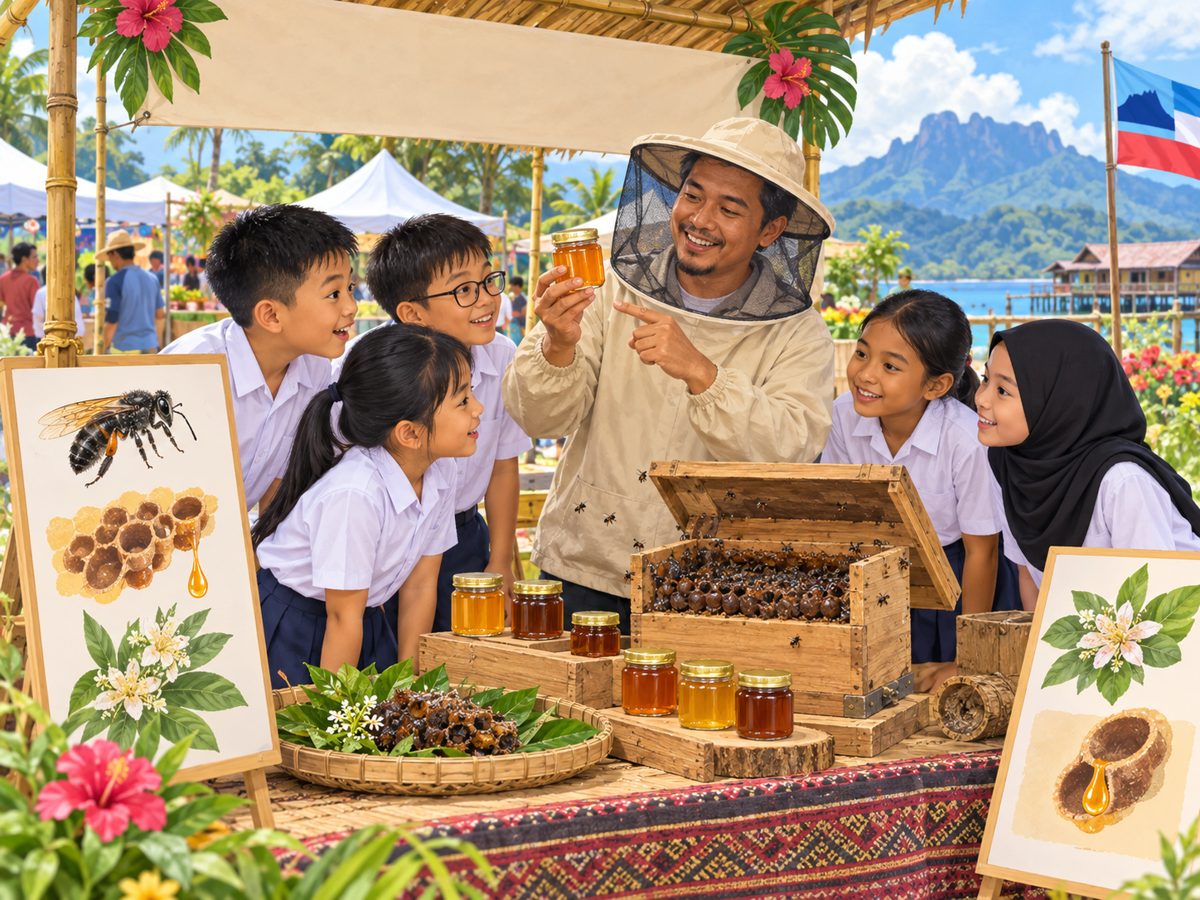
Penternak kini menggunakan inovasi, iaitu cara baharu yang lebih bijak. Ada yang membuat zoo mini, menjaga madu kelulut, mengeram telur ikan dalam botol terpakai dan membuat makanan kambing daripada batang jagung. Dalam unit ini: soalan bertumpu, idea keseluruhan, imlak, kata sendi nama, kata tanya dan kata perintah.
innovation = inovasi; livestock farming = penternakan; stingless bee = kelulut
This unit looks at new ideas in animal farming: turning a farm into a mini zoo for visitors, keeping stingless bee honey free from mould, hatching fish eggs in used bottles, and feeding goats with corn stalks. For language we learn closed questions, the overall idea, dictation, prepositions, question words and command words.
Example: a goat farmer chops and ferments corn stalks, giving his goats cheap and healthy feed.
Watch out: inovasi means a new way of doing things; it does not have to be an expensive machine.
Mendengar dan Bertutur
Soalan bertumpu
Baca poster, kemudian jawab soalan rakan.
LADANG KAMBING CERIA
Destinasi pendidikan pelancongan Waktu: 9.00 pagi hingga 5.00 petang Tutup: setiap hari Isnin
Bayaran masuk
Dewasa: RM10 Kanak-kanak: RM5
Aktiviti
memberi makan kambing melawat zoo mini merasa susu kambing segar
Soalan: Adakah ladang dibuka pada hari Isnin? Jawapan: Tidak, ladang itu ditutup setiap hari Isnin.
封闭式问题 = soalan bertumpu;目的地 = destinasi;小动物园 = zoo mini
封闭式问题的答案是固定的,可以直接在资料里找到,例如门票多少钱、星期一开不开。先听清楚问的是时间、价钱还是活动,再到海报上找那一格,最后用完整句子回答。
例子:问大人门票多少,答 Bayaran masuk untuk dewasa ialah RM10。
注意:Adakah 开头的问题,要先答 Ya 或 Tidak,再补一句说明。
closed question = soalan bertumpu; destination = destinasi; mini zoo = zoo mini
A closed question has one fixed answer that can be found in the information given, such as the ticket price or whether the farm opens on Monday. Listen for what is being asked, whether time, price or activity, find that box on the poster, and answer in a full sentence.
Example: asked how much an adult pays, we answer that the entrance fee for adults is RM10.
Watch out: for a question starting with Adakah, say Ya or Tidak first, then add a short explanation.
Mendengar dan Bertutur · Soalan 1
Berapakah bayaran masuk untuk kanak-kanak?
门票 = bayaran masuk;儿童 = kanak-kanak;大人 = dewasa
问题问的是儿童的门票,所以要看海报“Bayaran masuk”那一格里写着 Kanak-kanak 的那一行。RM10 是大人的价钱;RM15 是大人加小孩的总数,海报上没有这个答案。
例子:完整回答:Bayaran masuk untuk kanak-kanak ialah RM5.
注意:听到 Berapakah,就知道答案是一个数目或价钱。
entrance fee = bayaran masuk; children = kanak-kanak; adults = dewasa
The question asks about the children's fee, so look at the price box on the poster and find the line for kanak-kanak. RM10 is the adult price, and RM15 is an adult and a child added together, which the question did not ask for.
Example: a full answer is Bayaran masuk untuk kanak-kanak ialah RM5.
Watch out: when you hear Berapakah, expect the answer to be a number or a price.
Membaca
Idea keseluruhan petikan
Salutan nano untuk madu kelulut
Madu Kelulut Tahan Lama
Kelulut ialah lebah kecil yang tidak menyengat. Madunya masam manis dan disukai ramai. Namun, madu kelulut mudah rosak kerana kulat dan bakteria tumbuh di dalam bekasnya.
Kini, penyelidik menggunakan salutan nano. Lapisan yang sangat nipis ini disapu pada dinding bekas madu. Kulat dan bakteria sukar tumbuh di situ.
Hasilnya, madu kelulut tahan lebih lama. Penternak tidak lagi membuang madu yang rosak. Pembaziran dapat dikurangkan.
Idea keseluruhan: Salutan nano membantu madu kelulut tahan lama.
overall idea = idea keseluruhan; nano coating = salutan nano; mould = kulat; waste = pembaziran
The overall idea is what the whole passage says when all its paragraphs are put together, not a detail from one part. Here the paragraphs say the honey spoils easily, a nano coating is used, and the honey now lasts longer with less waste. Together: the nano coating helps the honey last.
Example: a passage about how Mother plants, waters and harvests vegetables is mainly about Mother growing vegetables.
Watch out: an overall idea must cover every paragraph; one that fits only a single paragraph is too narrow.
cover = merangkumi; without a sting = tanpa sengat; damp = lembap
That kelulut bees have no sting is only a small fact from the opening paragraph, and mould liking damp places is not written in the passage at all. Only the nano coating protecting the honey links all three paragraphs: the problem, the method and the result.
Example: a passage about recycling is mainly about protecting the environment, not about the colour of a bottle.
Watch out: a true fact is not automatically the overall idea; check whether it covers the whole passage.
Menulis
Menulis secara imlak
Dengar, ingat, kemudian tulis dengan betul.
Ayat yang dibacakan: Jeeva memberi landak raya makan ubi kayu dan garam mineral setiap pagi.
Huruf besar
awal ayat: Jeeva nama khas: Jeeva, Kuala Pilah
Tanda baca
noktah ( . ) di hujung ayat koma ( , ) antara senarai
Ejaan
landak raya, mineral, tumbesaran
听写 = imlak;豪猪 = landak raya;矿物盐 = garam mineral;成长 = tumbesaran
听写时先把整句听完,记在心里,再慢慢写。检查三件事:句子开头和人名、地名用大写;句末加句号,列举时用逗号;每个词的拼法要对。写完再从头读一遍。
例子:老师念 Jeeva memberi landak raya makan ubi kayu,Jeeva 的 J 要大写,最后加句号。
注意:landak raya 是普通名词,不用大写。
dictation = imlak; porcupine = landak raya; mineral salt = garam mineral; growth = tumbesaran
In dictation, listen to the whole sentence first, hold it in your mind, then write slowly. Check three things: capital letters at the start and for names of people and places; a full stop at the end and commas in a list; and correct spelling of every word. Then read it once more.
Example: when the teacher reads the sentence about Jeeva feeding the porcupine, Jeeva needs a capital J and the sentence ends with a full stop.
Watch out: landak raya is a common noun, so it stays in small letters.
Menulis · Soalan 3
Ayat imlak manakah yang betul?
大写 = huruf besar;句号 = noktah;人名 = nama orang
三句的词都一样,差别在大小写和标点。Jeeva 是人名,又在句首,必须大写;landak raya 是动物的普通名称,用小写;句子写完要有句号。只有一句三样都做对。
例子:Siti melawat ladang lembu di Keningau. Siti 和 Keningau 大写,lembu 小写。
注意:忘了句号也算错,听写时最容易漏掉。
capital letter = huruf besar; full stop = noktah; person's name = nama orang
The words in the three sentences are the same; they differ in capitals and punctuation. Jeeva is a name at the start of the sentence, so it needs a capital; landak raya is an ordinary animal name, so it stays small; and the sentence must end with a full stop. Only one sentence gets all three right.
Example: Siti melawat ladang lembu di Keningau has capitals for Siti and Keningau, but not for lembu.
Watch out: a missing full stop also counts as a mistake, and it is the easiest one to forget.
Tatabahasa
Kata sendi nama (1)
di, ke, dalam, daripada
Pak cik Hanafi mengeram telur ikan tilapia. Bekas pengeraman dibuat daripada botol plastik terpakai. Telur dikumpul di kolam, kemudian dimasukkan ke dalam botol. Dalam masa empat hari, telur menetas.
di
tempat: di kolam
ke
arah: ke dalam botol
dalam
tempoh: dalam masa empat hari
daripada
asal bahan: daripada botol plastik
介词 = kata sendi nama;孵化 = pengeraman;罗非鱼 = tilapia
介词放在名词前面。di 表示在哪里;ke 表示往哪里去;dalam 可表示在某段时间之内;daripada 表示东西用什么做成,也用在比较。这位叔叔用旧塑料瓶做孵化器,把鱼卵放进瓶里,四天内就孵出小鱼。
例子:Kerusi itu dibuat daripada kayu. 椅子是木头做的。
注意:从某个地方来要用 dari,例如 dari Sandakan;材料来源才用 daripada。
preposition = kata sendi nama; incubation = pengeraman; tilapia = tilapia
A preposition stands in front of a noun. Di tells where something is; ke tells where it goes; dalam can mean within a period of time; daripada tells what something is made from and is also used for comparing. The uncle makes an incubator from an old plastic bottle, puts the fish eggs inside, and they hatch within four days.
Example: Kerusi itu dibuat daripada kayu means the chair is made of wood.
Watch out: coming from a place uses dari, as in dari Sandakan; daripada is for materials and sources.
Tatabahasa
Kata sendi nama (2)
seperti, oleh, hingga
seperti
Telur tilapia kecil seperti biji sagu.
oleh
Botol itu dicuci oleh Hanif.
hingga
Air dialirkan dari pagi hingga petang.
像 = seperti;被 = oleh;直到 = hingga;西米 = biji sagu
seperti 用来比喻,说一样东西像另一样东西。oleh 用在被动句,告诉我们“是谁做的”。hingga 说明时间或地点的终点,常和 dari 一起用:dari pagi hingga petang(从早到晚)。
例子:Kandang itu dibina oleh ayah. 羊栏是爸爸建的。
注意:oleh 后面接做动作的人,前面的动词通常是 di- 开头。
like = seperti; by = oleh; until = hingga; sago pearl = biji sagu
Seperti compares one thing with another that looks or acts alike. Oleh is used in passive sentences to show who did the action. Hingga marks the end point of a time or place and often pairs with dari, as in from morning until evening.
Example: Kandang itu dibina oleh ayah means the pen was built by Father.
Watch out: the doer comes after oleh, and the verb before it usually begins with di-.
Tatabahasa · Padanan
Padankan kata sendi nama dengan fungsinya
功能 = fungsi;做的人 = pembuat;终点 = had
左边五个介词各有一个用途:表示地点、方向、动作是谁做的、材料来源、时间的终点。不确定时,自己用那个词造一个短句,例如 pergi ke kolam,就知道 ke 是讲方向。
例子:Kami belajar hingga pukul dua. hingga 讲时间到哪里为止。
注意:di 和 ke 很像,di 是“在”,ke 是“去”。
function = fungsi; doer = pembuat; limit = had
Each of the five prepositions on the left has one job: showing a place, a direction, who did an action, what something is made from, or where a time ends. If unsure, make a tiny sentence with the word, such as pergi ke kolam, and you will see that ke shows direction.
Example: Kami belajar hingga pukul dua shows how long the studying lasts.
Watch out: di and ke look alike, but di means at and ke means to.
Tatabahasa · Soalan 4
Pilih kata sendi nama yang betul.
Anak ikan itu kecil ________ jarum.
比喻 = perbandingan;小鱼 = anak ikan;针 = jarum
句子把小鱼的大小和针相比,说小鱼像针一样细小,所以要用 seperti。daripada 讲材料或“比……更”,oleh 讲被谁做,这两个都不能表示“像”。
例子:兔子的毛软得像棉花一样,马来文说 lembut seperti kapas。
注意:要说“比……大”就用 lebih besar daripada,不能用 seperti。
comparison = perbandingan; baby fish = anak ikan; needle = jarum
The sentence compares the size of the baby fish with a needle, saying it is as small as one, so we need seperti. Daripada is for materials or for saying more than, and oleh shows who did an action, so neither can mean like.
Example: Bulu arnab itu lembut seperti kapas means the rabbit's fur is soft like cotton.
Watch out: to say bigger than, use lebih besar daripada, not seperti.
Tatabahasa
Kata tanya
Lawatan ke kolam udang galah
Ayah Nabila: Apa khabar, Encik Izam? Berapakah jumlah kolam encik?
Encik Izam: Saya ada enam kolam udang galah.
Nabila:Mengapakah encik menggunakan air bukit?
Encik Izam: Kerana air bukit bersih dan tiada klorin.
Nabila:Bilakah udang ini boleh dijual?
Encik Izam: Selepas empat bulan.
apa · siapa
benda · orang
berapa · bila
jumlah · masa
bagaimana · mana · mengapa
cara · tempat · sebab
疑问词 = kata tanya;淡水大虾 = udang galah;氯 = klorin
不同的疑问词问不同的东西:apa 问东西,siapa 问人,berapa 问数量,bila 问时间,bagaimana 问方法,mana 问地方,mengapa 问原因。后面加 -kah 会更正式。先想清楚你想知道什么,再选疑问词。
例子:想知道养了几个虾池,就问 Berapakah jumlah kolam encik?
注意:答案以 kerana 开头,问题多半是用 mengapa 问的。
question word = kata tanya; giant freshwater prawn = udang galah; chlorine = klorin
Each question word asks for something different: apa for things, siapa for people, berapa for amounts, bila for time, bagaimana for ways, mana for places and mengapa for reasons. Adding -kah makes it more formal. Decide what you want to know before choosing the word.
Example: to find out how many ponds there are, ask Berapakah jumlah kolam encik?
Watch out: if the answer begins with kerana, the question most likely used mengapa.
Tatabahasa · Soalan 5
Pilih kata tanya yang sesuai.
________ pak cik menggunakan air bukit? Kerana air bukit bersih dan sejuk.
原因 = sebab;为什么 = mengapakah;怎样 = bagaimanakah
答案说“因为山水干净又凉”,是在讲原因,所以问题要问“为什么”。bagaimanakah 问做法,答案会是一步一步的方法;siapakah 问人,答案会是名字。
例子:Mengapakah kamu lewat? — Kerana hujan lebat. 为什么迟到?因为下大雨。
注意:先看答案,再倒回去选疑问词,就不容易错。
reason = sebab; why = mengapakah; how = bagaimanakah
The answer says it is because hill water is clean and cool, so it gives a reason and the question must ask why. Bagaimanakah asks for a method, which would be answered with steps, and siapakah asks for a person, which would be answered with a name.
Example: Mengapakah kamu lewat? Kerana hujan lebat. Why are you late? Because of heavy rain.
Watch out: read the answer first, then work backwards to choose the question word.
Tatabahasa
Kata perintah
Membuat makanan kambing daripada batang jagung
Pak Long: Hari ini kita membuat makanan kambing. Jangan dekati mesin peracik itu.
Hanif: Baiklah. Pak Long, tolong terangkan cara membuatnya.
Pak Long: Batang jagung diracik halus, kemudian dicampur aditif. Sila lihat tong pemeraman ini.
Hanif: Kambing pasti suka!
Larangan
jangan, usah
Permintaan
tolong, minta, harap
Silaan
sila, jemput
祈使词 = kata perintah;切碎 = meracik;发酵 = pemeraman
祈使词有三类:叫人不要做的 jangan、usah;请人帮忙的 tolong、minta、harap;客气邀请的 sila、jemput。对话里,伯父教 Hanif 把玉米秆切碎、加添加物、放进桶里发酵,做成羊饲料。
例子:Harap simpan tong itu di tempat teduh. 请把桶放在阴凉处。
注意:tolong 是请别人帮我做,sila 是请别人自己做。
command word = kata perintah; chop finely = meracik; fermentation = pemeraman; additive = aditif
Command words come in three groups: jangan and usah forbid; tolong, minta and harap make a request; sila and jemput politely invite. In the dialogue, the uncle shows Hanif how corn stalks are chopped, mixed with an additive and fermented in a tub to make goat feed.
Example: Harap simpan tong itu di tempat teduh asks someone to keep the tub in a shady place.
Watch out: tolong asks someone to do something for me, while sila invites the person to do it for himself.
request sentence = ayat permintaan; close = tutup; goat's milk = susu kambing
All three sentences ask someone to do or not do something, so check the opening command word. Tolong asks for help, which makes it a request. Jangan forbids, so it is a prohibition, and jemput politely invites someone to taste, so it is an invitation.
Example: Minta adik ambilkan baldi itu asks a younger sibling to fetch the bucket.
Watch out: jemput also sounds polite, but it invites rather than asks for help.
Ringkasan
Syabas!
Inovasi menjadikan penternakan lebih maju.
Kita belajar soalan bertumpu, idea keseluruhan, imlak, kata sendi nama, kata tanya dan kata perintah larangan, permintaan dan silaan.