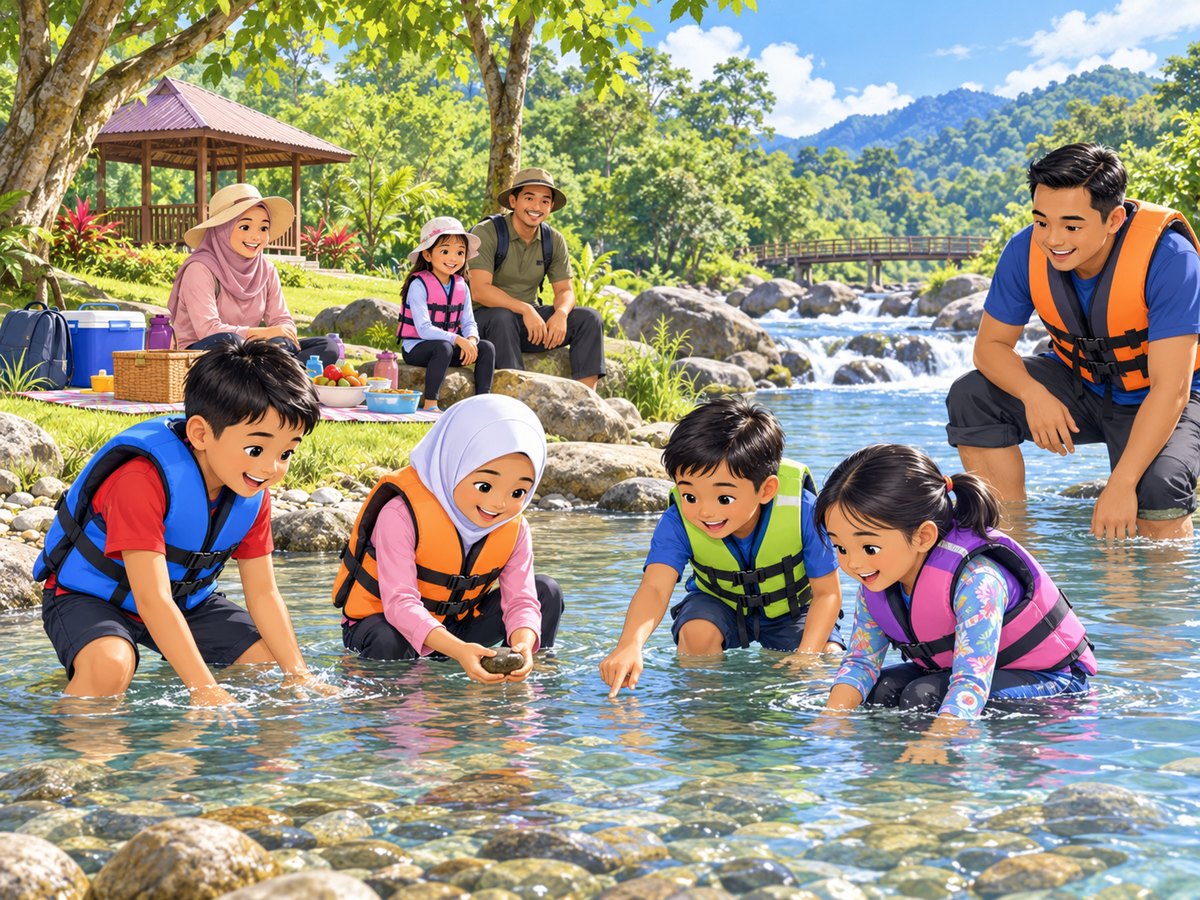
Rekreasi membuat badan cergas dan hati gembira. Namun, kita mesti memakai alat keselamatan dan mematuhi peraturan. Dalam unit ini, kita mengenal kelengkapan menunggang kuda, panjat tembok tiruan, rakit, kata perintah dan kata seru.
recreation = rekreasi; safety equipment = alat keselamatan; follow the rules = mematuhi peraturan
Horse riding, wall climbing and rafting are fun outdoor activities that keep the body fit and the mind happy. Before we start, we must wear the right gear and listen to the instructor. This unit also covers two word groups: command words (kata perintah) and exclamations (kata seru).
Example: put on a helmet before riding a horse, and a harness before climbing a wall.
Watch out: the more exciting the activity, the more important safety becomes, so never skip the gear.
Mendengar dan Bertutur
Kelengkapan menunggang kuda
Farah dan ibunya di pusat ekuestrian.
Farah: Maaf, encik. Bolehkah saya bertanya tentang kasut but ini?
Jurulatih: Boleh. Kasut but melindungi kaki dan tidak mudah tergelincir.
Farah: Terima kasih, encik. Saya akan memakai topi keledar juga.
topi keledar
melindungi kepala jika terjatuh
pelana
tempat duduk di atas belakang kuda
tali kekang
tali untuk mengawal arah kuda
kasut but
kasut tinggi yang melindungi kaki
头盔 = topi keledar;马鞍 = pelana;缰绳 = tali kekang;马靴 = kasut but
Farah 和妈妈到马术中心骑马。骑马要准备四样东西:头盔保护头部,马鞍是坐在马背上的座位,缰绳用来控制马走的方向,高筒马靴保护脚,也不容易滑。Farah 问教练时先说“Maaf, encik”,最后说“Terima kasih”,这就是有礼貌的说话方式。
例子:Maaf, puan. Bolehkah puan tunjukkan cara memegang tali kekang?
注意:向大人发问时,用 encik、puan 称呼对方,不要直接叫“kamu”。
helmet = topi keledar; saddle = pelana; reins = tali kekang; riding boots = kasut but
Farah and her mother visit an equestrian centre. A rider needs four items: a helmet protects the head, the saddle is the seat on the horse's back, the reins steer the horse, and tall boots protect the feet and stop them slipping. Farah opens with 'Maaf, encik' and ends with 'Terima kasih', which is the polite way to speak.
Example: Maaf, puan. Bolehkah puan tunjukkan cara memegang tali kekang?
Watch out: address adults as encik or puan, never simply as 'kamu'.
Mendengar dan Bertutur · Soalan 1
Penunggang mahu kuda berjalan ke kiri. Alat manakah yang digunakan untuk mengawal kuda?
控制 = mengawal;缰绳 = tali kekang;皮革马鞍 = pelana kulit
骑马的人想让马往左走,要用手拉的那条绳子,也就是缰绳。马鞍是坐的地方,不能改变方向;马靴穿在脚上,用来保护脚。想一想骑马时双手握着什么,就知道答案。
例子:Pak Din menarik tali kekang perlahan-lahan supaya kuda berhenti.
注意:pelana 是“坐”的,tali kekang 才是“控制”的,别把两个弄反。
control = mengawal; reins = tali kekang; leather saddle = pelana kulit
To make the horse turn left, the rider pulls the straps held in the hands, which are the reins. The saddle is only a seat and cannot change the direction, while boots are worn on the feet for protection. Think about what the rider's hands hold, and the answer is clear.
Example: Pak Din menarik tali kekang perlahan-lahan supaya kuda berhenti.
Watch out: pelana is for sitting and tali kekang is for steering; do not swap them.
Membaca
Idea utama dan idea sampingan
Panjat tembok tiruan
Pemanjat tembok tiruan mesti memakai alat keselamatan. Topi keselamatan melindungi kepala daripada hentakan. Tali abah-abah dipakai pada pinggang dan disambung pada tali keselamatan. Kapur tangan menjadikan tangan kering supaya tidak licin. Pelindung lutut menghalang lutut daripada luka.
Idea utama
Pemanjat mesti memakai alat keselamatan. (ayat berwarna kuning)
Idea sampingan
fungsi topi keselamatan, tali abah-abah, kapur tangan dan pelindung lutut
主要思想 = idea utama;次要信息 = idea sampingan;人工攀岩墙 = tembok tiruan
每一段文字都有一个最重要的意思,叫 idea utama,通常在第一句。后面的句子补充说明,叫 idea sampingan。这段的主要思想是“攀岩的人一定要穿戴安全装备”,后面四句分别说明头盔、安全吊带、防滑粉、护膝各有什么用。
例子:段落讲“玩水要小心”,后面说穿救生衣、不在深水区玩,这些都是补充。
注意:idea utama 是整段在讲的事,范围比较大;只讲一种装备的句子是 idea sampingan。
main idea = idea utama; supporting idea = idea sampingan; artificial wall = tembok tiruan
Every paragraph has one most important point, called the idea utama, usually in the opening sentence. The sentences after it add detail and are called idea sampingan. Here the main idea is that climbers must wear safety gear, and the next four sentences explain the helmet, harness, chalk and knee guards.
Example: if a paragraph says to be careful in water, the lines about life jackets and avoiding deep water are supporting ideas.
Watch out: the main idea covers the whole paragraph; a sentence about only one piece of gear is a supporting idea.
Membaca · Soalan 2
Apakah idea utama perenggan ini?
Panjat tembok tiruan memberi banyak faedah. Otot tangan dan kaki pemanjat menjadi lebih kuat. Kita menjadi lebih berani mencuba perkara baharu. Kita juga belajar memberi tumpuan.
benefit = faedah; muscle = otot; brave = berani
The paragraph first says wall climbing has many benefits, then lists stronger arm and leg muscles, more courage and better focus. Which sentence wraps up all the others? It is the one about the many benefits. Stronger muscles and more courage are each just one benefit, so they are supporting ideas.
Example: if a paragraph is about why breakfast matters, the line saying breakfast gives us energy is only one supporting reason.
Watch out: to find the main idea, ask whether the sentence sums up the whole paragraph.
Menulis
Rakit buluh dan rakit getah
Bandingkan dengan peta buih berganda.
Rakit buluh
Persamaan
Rakit getah
dibina daripada batang buluh
terapung di atas air
diperbuat daripada getah dan diisi angin
berat dan keras
digunakan di sungai
ringan dan lembut
dikawal dengan kemudi
penumpang perlu memakai jaket keselamatan
digerakkan dengan pendayung
Persamaan di tengah. Perbezaan di kiri dan di kanan.
bamboo raft = rakit buluh; rubber raft = rakit getah; rudder = kemudi; paddle = pendayung
Kavin rides a rubber raft with his grandfather, who remembers riding bamboo rafts long ago. A double bubble map compares them: similarities go in the middle, such as floating on water, being used on rivers and needing life jackets. Differences go on each side: the bamboo raft is heavy, hard and steered with a rudder; the rubber raft is inflated, light, soft and moved with paddles.
Example: 'both need life jackets' sits in the middle, while 'made of bamboo' belongs only on the bamboo side.
Watch out: when comparing, match the same feature on both sides, such as material with material.
similarity = persamaan; both = kedua-duanya; inflated = diisi angin
A similarity must be true for both rafts. 'Made of bamboo' fits only the bamboo raft, and 'must be filled with air' fits only the rubber raft. Only 'used on rivers' is true for both, so it is the real similarity.
Example: a bicycle and a motorcycle are similar because both have two wheels, not because both need petrol.
Watch out: test each sentence on both items before calling it a similarity.
Tatabahasa · Kata Perintah
Kata perintah
Larangan, permintaan dan silaan
Jenis
Kata perintah
Contoh di taman rekreasi
Larangan
jangan, usah
Jangan menunggang basikal di atas rumput. Usah bimbang, ayah ada di sini.
Permintaan
tolong, minta, harap
Tolong pegangkan topi keledar saya. Harap beratur di belakang garisan.
Silaan
sila, jemput
Sila pakai topi keledar. Jemput minum air sejuk ini.
祈使词 = kata perintah;禁止 = larangan;请求 = permintaan;邀请 = silaan
祈使词放在句子开头,用来叫别人做或不做某件事,分三组。禁止:jangan、usah(不要)。请求:tolong(请帮忙)、minta(要求)、harap(希望大家)。邀请:sila(请)、jemput(欢迎、请享用)。在公园骑脚踏车时,这些词常出现在告示牌上。
例子:Jangan berlari di tepi kolam. 是禁止;Sila duduk. 是邀请。
注意:jemput 多用在请人吃、喝或来参加;叫人别做的事要用 jangan 或 usah。
command word = kata perintah; prohibition = larangan; request = permintaan; invitation = silaan
Command words come at the start of a sentence to tell someone to do or not do something, and they fall into three groups. Prohibition: jangan and usah (do not). Request: tolong (please help), minta (ask for) and harap (we hope you will). Invitation: sila (please) and jemput (you are welcome to). They often appear on signs at a recreation park.
Example: Jangan berlari di tepi kolam. is a prohibition; Sila duduk. is an invitation.
Watch out: jemput is mostly for offering food, drink or an event; to forbid something, use jangan or usah.
Kata Perintah · Soalan 4
Pilih kata perintah yang sesuai.
______ masuk ke dalam trek semasa perlumbaan berlangsung.
跑道 = trek;比赛 = perlumbaan;进行中 = berlangsung
比赛进行时走进跑道非常危险,所以这句话是在禁止大家做这件事,要用禁止词 Jangan。Jemput 是邀请人来做好事,用在这里意思会变成“欢迎进入跑道”;Tolong 是请人帮忙,也说不通。
例子:Jangan bersandar pada pagar trek itu.
注意:先判断句子讲的是危险的事还是好事,危险的事就用禁止词。
track = trek; race = perlumbaan; taking place = berlangsung
Walking onto the track during a race is very dangerous, so this sentence forbids it and needs the prohibition word Jangan. Jemput invites someone to do something pleasant, so it would sound like a welcome onto the track. Tolong asks for help, which also makes no sense here.
Example: Jangan bersandar pada pagar trek itu.
Watch out: first decide whether the action is dangerous or pleasant; dangerous actions take a prohibition word.
Kata Perintah · Bina ayat
Susun ayat larangan
禁止句 = ayat larangan;忘记 = lupa;戴 = memakai
把五张字卡排成一句提醒的话:“不要忘记戴头盔。”禁止句以禁止词 Jangan 开头,接着是 lupa(忘记),然后是动作 memakai(戴),最后是东西 topi keledar(头盔),句号跟着最后一个词。
例子:Jangan lupa membawa botol air.
注意:topi 和 keledar 是一个词组,要排在一起,不能分开。
prohibition sentence = ayat larangan; forget = lupa; wear = memakai
Arrange the five cards into a reminder that means 'do not forget to wear a helmet'. A prohibition sentence begins with Jangan, followed by lupa (forget), then the action memakai (wear), and finally the item topi keledar (helmet), with the full stop on the last word.
Example: Jangan lupa membawa botol air.
Watch out: topi and keledar form one phrase, so keep them side by side.
exclamation word = kata seru; puzzled = hairan; surprised = terkejut; amazed = kagum; comma = tanda koma; exclamation mark = tanda seru
A kata seru expresses a feeling. It comes first in the sentence, is followed by a comma, and the sentence ends with an exclamation mark. Eh shows you are puzzled or startled, Nah hands something over, Wah shows amazement, Oh shows surprise or amazement (it can also mean you suddenly understand), Amboi mixes surprise with admiration, and Syabas happily praises good work.
Example: Wah, cantiknya gua ini! is said when admiring a beautiful sight.
Watch out: a comma follows the exclamation word, and the exclamation mark comes only at the end.
Kata Seru · Soalan 5
Pilih kata seru yang sesuai.
______, ambillah lampu suluh ini supaya kamu tidak terjatuh!
torch = lampu suluh; hand over = menghulurkan; fall = terjatuh
The speaker is passing a torch to a friend and saying take it so you do not fall. The exclamation used when handing something over is Nah. Oh shows surprise or amazement and Syabas praises someone, so neither is about giving an item.
Example: Nah, ini topi keledar kamu!
Watch out: Nah is often followed by 'ambillah' or 'ini', because the speaker is holding something out.
Kata Seru · Soalan 6
Ayat manakah yang betul tanda bacanya?
标点符号 = tanda baca;宽敞 = luas;洞穴 = gua
感叹句的标点有固定位置:感叹词 Wah 后面是逗号,整句最后是感叹号。另一种写法把感叹号放在 Wah 后面、句尾用句号,位置弄反了;还有一种把逗号放在中间、结尾用问号,变成像在发问,也不对。
例子:Eh, ada air menitis dari atas!
注意:感叹句不是问句,不能用问号结尾。
punctuation = tanda baca; spacious = luas; cave = gua
Punctuation in an exclamation has fixed places: a comma after the word Wah and an exclamation mark at the very end. Another version puts the exclamation mark after Wah and a full stop at the end, which swaps them. A third places the comma in the middle and ends with a question mark, which turns it into a question.
Example: Eh, ada air menitis dari atas!
Watch out: an exclamation is not a question, so it never ends with a question mark.
matching = padanan; puzzled = hairan; praise = memuji
Match the four exclamation words with the feelings they show. Picture the speaker's face: Eh when something seems strange, Nah when holding something out, Oh when a huge stalagmite brings surprise and amazement, and Syabas when a friend has done well and you praise them happily.
Example: Oh, besarnya kelawar itu!
Watch out: Eh is mostly for feeling puzzled, Oh is for surprise or amazement, and Syabas is happy praise for a person.
Ringkasan
Syabas!
Berekreasi dengan selamat dan gembira.
Pakai alat keselamatan, cari idea utama, bandingkan dengan teliti, gunakan kata perintah dan kata seru dengan betul.